Menu:

Aiki Jo, Japanese short staff.

Aiki Jo,  principles, practice and local class on an art developed by Saito Sensei 9th Dan based on the teachings of the founder of Aikido.

Watch the space below for information, hints and tips on Aiki Jo. The system of use for the Japanese short staff as favoured by the Founder of Aikido, Morihei Ueshiba.

From 4th November 2009
There is a class at the Methodist Church Hall, High Street,  Bideford each Wednesday evening 7.00 to 900 pm

Class cost £3  for beginners, who can attend the first hour from
7 to 8 pm. More experienced students can practice for the entire 2 hours for only £4.    (Jo can be supplied at class.)


This class can be used as an exercise system - but it also has that 'extra something' that pleases the spirit as we search for the way of harmony of spirit.

New students  always  welcome, as are old friends too. 
Don't let time or age deter you, you are your own destiny.

**************

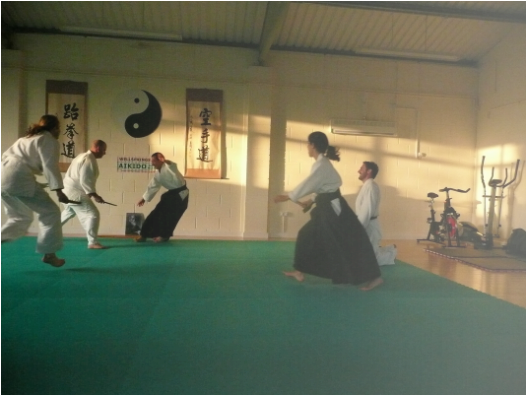
New improved home for Aiki Jo class.

Picture


Instructor;  Richard Small 3rd Dan with Takemusu Iwama Aikido Europe.
We are looking forward to starting our class in our new home of the Methodist Church Hall, High Street, Bideford. Car parking is free in the evening at the public car park to the rear. If you are interested in martial arts, particulary how the Jo practice may develop your overall knowledge please come along. At the same time complete beginners are also welcome. The type of Jo training we do is taken from Aikido as taught by the late Saito Sensei 9th dan.

***********

Picture

Workshop to study the six Jo Awase, as taught by Sensei H. Hoa Newens 6th Dan.

Students on the workshop had the chance to see some fine teaching of the six blending exercises, from kihon to kinonagare. It was particularly interesting to 'feel' the effect of what looks to the casual observer to be a powerless avoidance but in fact is a powerful connective force through to the attacker's body. Based on co-ordinated body movement acting through the Jo from the attacked person. Very interesting and intriguing insight into Jo Awase. Our Thanks to Sensei Mark for all his efforts for us.  Richard

Aiki Jo workshop taught by Sensei Mark Allcock,


2nd Dan Takemusu Iwama Aikido Europe. 
Bideford, North Devon.

Saturday 18th July 2009

2.00 pm to 4.00 pm

Subject;-  will be the 6 Jo Awase as taught by H. Hoa Newens 6th dan.. 

Most of the moves are required in the Kumijo  Jo matching exercise (partner practice) and so will be useful as a prerequisite to Kumijo.

Awase - Blending movement; from verb awaseru, to blend, harmonize. Frequently used in aikido to evoke the notion of harmony with the movement of one's partner.

About Mark Allcock;- Started Aikido in 1994  2nd Dan in 2007.  

 qualified British Wheel of Yoga teacher
 Tai Chi. -  practising for a number of years.

particularly interested in yoga to complement sports, recently starting a yoga class specifically for martial artists so combining  love of yoga and aikido


more detail is contained in Mark's own page within www.yogawithanne.co.uk

Picture


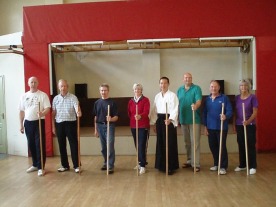
Above left, Sensei Mark Allcock 2nd Dan; above right, group photo taken at the workshop, 18th July 2009, Bideford, North Devon.


*************

Poole, Dorset 18th April 2009, weapons course.

A workshop of enlightening import; The fine detail about WHY something is done and HOW you need to respond. The difference between exercises designed for blending and harmony and exercises to examine martial skill with an order of events that complement those of real life. Both Jo and Ken were practiced. (Ken = wooden sword) Where and when the power is manifested and how little effort is required, the relevance of feet postures and values of these and body posture........... all this and more ... what a day.

More than half the students were black belt level, and those that weren't were keen to be there too, a studious group that took on board the essence of the teaching, and jolly nice people at that. They had travelled from Suffolk, Cambridgeshire, Devon and Berkshire to meet in friendship and study the art together.


                                       *************************


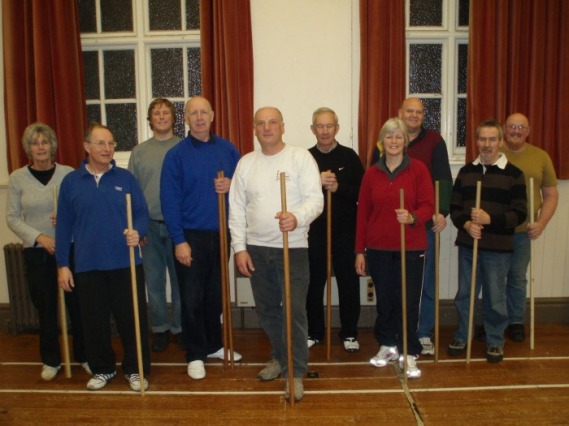
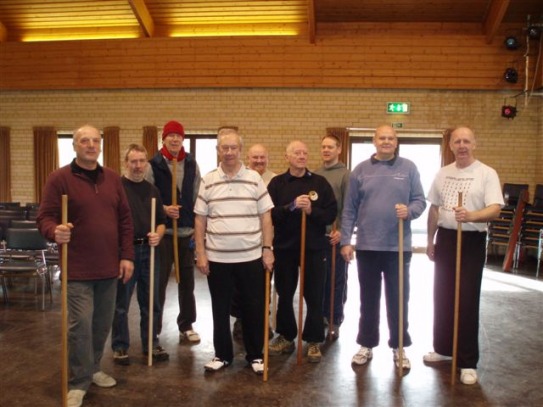
Aikido and Aiki Jo students, at Bideford, with 6th dan

Sensei Tony Sargeant, (centre).
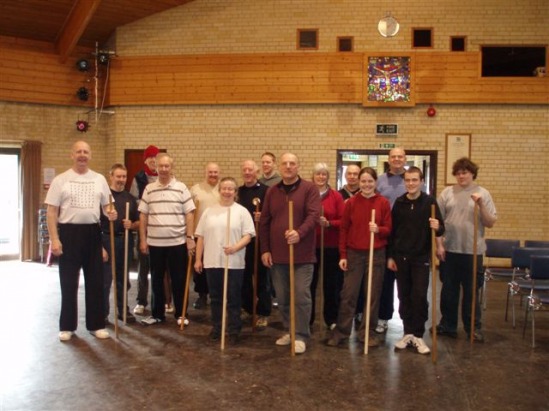
Young and old together pose for a group photo after enjoying a two hour workshop.

Jo workshop on 22nd February 2009 in North Devon;

The instructor  - Sensei Tony Sargeant 6th Dan (Japan)


Normally residing in Greece but visiting the UK for this and other workshops.


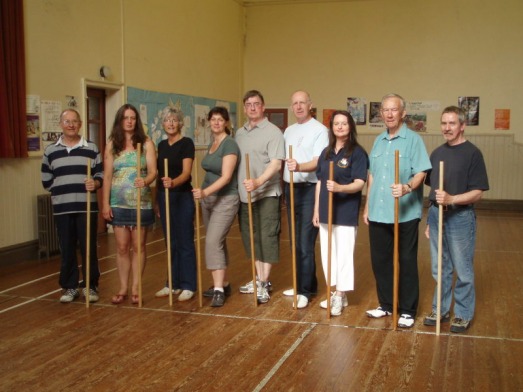
       Members of the 'Martial arts for oldies' group that trains in Bideford, of course they're not all old ! Left to right - the visiting teacher Sensei Tony Sargeant founder and principal of Takemusu Iwama Aikido Europe, Patrick, John, Michael, Paul, Colin, James, Morgan and Richard, who runs the local class.

During the workshop students had insights into the importance of body balance and timing in the use of the Jo. They explored the 6 kata and the key elements of positioning; some partner work, including parries from attacks to knee, kidneys and head. The essence of internal working and the requirements for the mental approach to Jo work were also paramount in the lesson.

You had to be there to understand ... and even then much practice will be required to put the understanding into action. ........ we're going to give it a good try at our local class.

                                            ***********************


North West Russia.   (Sensei Tony Sargeant in centre.)

This photo was taken in the late 1990's, there seems to me to be a sense of power that pervades the picture. Though it looks more like a mafia convention it was indeed an Aikido Seminar. (Ai -harmony ... ki - spirit ..... do - the way) where we saught a peaceful way to enlightenment under the guidance of Sensei Sargeant and McGlone. (Sensei - teacher)


Myself, left, with Sensei John Garmston of Reading

As I am trying to promote the Aiki Jo class I thought I'd better put something here that might encourage you to come.

No amount of writing or fine words can substitute for actually seeing the teacher, but knowing where they are coming from might make you interested enough to go and look!

I started Aikido in the mid 1970s, going oh so slowly through the grades until I was awarded 3rd Dan in2007 at Cambridge by Senseis Tony Sargeant and Paul McGlone.

Some of the teachers that I have seen on workshops or seminars are listed below, and in no particular order.  Pat Hendricks,6th dan, Toyoda Shihan, Saito Sensei 9th dan, Bill Smith, 5th dan when I saw him, Mathew Hill, Bill Harris, Miles Kessler, Kanetska Sensei, Chiba Sensei 8th dan, Yamada Sensei 8th dan, Tamura Sensei, 9th dan - if not should be ... brilliant, Daniel Toutan, Andre Noquet and many more.

I'm not saying I can do what they do ... I just saw what they did ... hoping some inspiration would come my way, some small gem would always be mine to take home.

I trained in Holland, Switzerland, France, Greece, Russia and Jersey as well as the mainland UK, I attended something like 130 courses, excluding teaching and coaching courses. I was lucky to teach at Sensei Sargeant's Orwell Dojo on a regular basis and was invited to teach in Holland while a resident teacher was on holiday. I like teaching, it gives me great satisfaction.

Now living away from the main group of my association I do not teach Aikido ... lots of excuses, no mats, old age ...... but I like the Jo and am able to teach this.

Jo form being looked at - 20 suburi; 13 kata; 31 kata; 6 kata; some partner work and applications where appropriate.

The Jo is a fundamental and inherent part of Aikido. Practice should improve balance, co-ordination, self knowledge and discipline as well as physical power. It is suitable for men and women. No special clothing needed - unless you have it and want to wear it.

We will stick to sound safety rules and etiquette.
                                                       *****************


Above; an uchideshi group in the Korianna Dojo, Kefalonia.
*************

If you are an Aikido student or follow another Martial art that uses the short staff or Jo, then this class might interest you.

The founder of Aikido, Morihei Ueshiba, used the Jo as preparation against bayonet and spear, but  it also provided a means to co-ordinate body timing and power.

O’Sensei had a student called Morihiro Saito, he was a regular and loyal student for the last 23 years of O’Sensei’s life, he looked after him in his old age, he taught for O’Sensei at the Iwama Dojo, the home of Aikido.

  Saito Sensei was graded 9th Dan and given the job of developing Jo into a teaching system. O’Sensei’s Jo practice was too extensive even for Saito to remember, but he did his best to adhere to his teacher’s principles, and be true to the art.

 
  My own teacher, Tony Sargeant 6th Dan was a long term student of Saito Sensei, and is still true to his late Sensei's teachings and his style of Aikido emphasises the part of weapons more than other styles.

I have followed Tony Sargeant since the mid 1980s and hold him in the highest regard for his skills and generosity of teaching.

Just think, if you come to my class there will only be three people between you and the founder, O'Sensei! I'm afraid the skill level will be lacking but should be enough to move your own forward.

Come and find out if it can!  Always welcome.

Above; a TIA Europe seminar in Cambridge. 
Below; Assisting at martial arts demo - South Molton 23rd Aug 2008
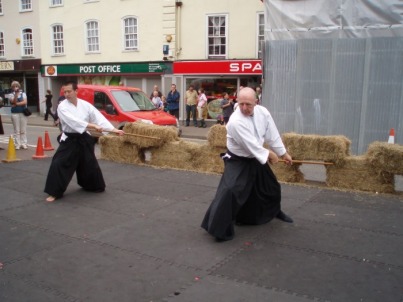
The end form of the suburi, katate toma uchi, Mark Allcock from Dorset on left (2nd Dan) and myself (the old one on the right). We joined in a Martial arts demonstration organised  to publicise the pannier market


1997, Saint Petersburg, Russia. Sensei Sargeant demonstrates a sacrifice throw. (left)

A young Victor executes a different throw. (right). This is not something we are training for in our Bideford class !!! 

Principles of Jo - by Paul Lowing of TIA Europe

The principles are rather easier to demonstrate and have the student feel than to explain using the written word... Having said that let me make an attempt.

You rightly point out is that sticking a weapon in a beginner's hands instantly seems to produce an imitation of a marauding caveman with a club... I don't know why it just seems to happen.

Sorting out the posture and moving from the hips tends to take care of a lot of potential problems by naturally producing correct movement, so lets start with generalities about the posture.

Head should be held erect

Shoulders relaxed
The hips should be "loaded" at all times, even during tsuki which can appear otherwise. By loaded I mean turned in the opposite direction to the shoulders. E.g for a right side strike the left hip pushes forward and vice versa (the classic iwama style weapons stance). This twist is small in tsuki but should still be there. By keeping this loading as one moves from stance to stance one is always ready to continue the next move.
Weight should either be forward in a forward stance (e.g. a strike) or back or a rear stance (e.g. a rising block) NEVER 50:50!
Torso should be upright generally, (or occasionally in a straight line with the back leg on certain moves.).

Assuming a ken-type stance the arms should be extended, but there should be a overall feeling of roundedness within the extension. The arms are relaxed, the hands grip firmly starting with the little finger, then slightly less tightly with the third finger, slightly less tightly again with the second finger. First finger and thumb grip lightly. Little finger of the left hand is on the edge of teh hilt or end of jo. Approximately a hand-width gap between the hands in a striking posture and the knuckles of the first finger of both hands should engage on the upper part of the weapon to give a firm hold without any "cushioning" as can be felt if the weapon is held with the hands vertical and the weapon pressed upward.

All movements start from the hips. When stepping forward from a forward stance the weight shifts forward such that the front leg powers the step right from the commencement of the movement and all thte way through. Failure to do this means that the step becomes a "float" forward until the front foot becomes the rear foot and then drives the movement forward; this is poor technique.

The hips drive the strike (or thrust) and the hips raise the weapon. Arms must be relaxed and integrated with the centre.
If the hips power the movements with the correct weight distribution the footwork pretty much will take care of itself.

Focus is to look through the target to infinity and you should be aware of everything in your peripheral vision. The eyes are "softened" to allow this.

Intention is to strike or thrust through the target and then move on. This is done cleanly and coolly, no aggression, but determination.

The weapon is also an "antenna" if held correctly and will feed back to you your opponents intentions. If it is held with arm and shoulder strength it will feedback nothing and be a crude bludgeon only.

Once an attack (or defence) has gone, it has gone, do not try and "win" on one strike, move to the next immediately, don't get tied up in a contest of strength.

A sword is a precision instrument and should be wielded as such.

Bit "stream of conciousness" but this is a start.


                                          ************

This is an excellent 'gift' from Paul Lowing and I commend it to you. I have made bold some of the key points. Paul is senior instructor at Keighly Aikido Club and determined student of the art. More details of Paul may be found on the links page via the Takemusu Iwama Aikido web site.

Thank you Richard.

                                                                         ******

The value of Jo.

The Jo is a short staff, good ones made of Japanese Oak, it's length varies with the user ( standing from the ground to just under the armpit). Because of it's length and the opportunity to use both ends, it can be used in carrying out techniques from Bo (long staff), sword and spear.

Using the Jo involves relaxed postures and movements except for the moment of impact.

Being relaxed allows quicker movement, more whole body co-ordination and a degree of flexibility, should the need arise to change direction.

Originally the founder had three parts to his art called Aikido:

1. Body techniques
2. The Ken, a wooden sword
3. The Jo, a wooden staff


They were used to achieve simple understanding. Saito Sensei (9th Dan) said when you use the weapons think of body movements; when you use body movements think of the weapons


Value of Kata

Kata is a word to describe a set of predetermined movements which the student practices to improve skill, body timing, co-ordination etc ....... but it should be more!

'If you have to prepare then you were never ready'

Each move should be meaningful, it must fit the perceived attack, it must result in the opponent being in a worse position than you, each move is 'in the now', as if it was the first move ever made, each move must be as perfect for purpose as you can make it, keeping to the principles of a relaxed and co-ordinated body.

Practicing the Suburi (20 of them) will improve skills in balance, focus and technique, to enhance the Kata, and if done slowly will enable the student to discover any weakness and how to co-ordinate the inner body as well as the outer. The Kata is the opportunity to put in your skill, and not some empty headed choreographed dance. Practice makes perfect, but only perfect practice ! Exercises and drills will help your body and mind, and the Kata adds interest of varied movements so that you can continue that development.

'That's dragon body' he said.....

I had just returned from  a brilliant two day workshop taught by Sensei Tony Sargeant in Reading. I had discovered much about the Aikido I had practised for years but never really understood .... now the light was on ! What did I learn? Be in the centre - your centre ! Move in harmony with all, no aggression, no dominance, don't be the attacker ..... and oh how easy that is to become even in practice. Work hard for the truth ... tricks are powerful but they are just tricks, so seek the truth. Use the hips ... but don't use the word hips or others will misunderstand. I demonstrated one of the ken suburi but using the Jo to some Tai Chi practitioners, I used the 'hips' as taught and Steve said ' hey, that's dragon body'. In this case with a strong involvement with the Kua, or hip crease.  (Used in hsing Yi and other internal arts) Want to know more?           27.3.09.